
Thermal Lamination Film for Printed Packaging: BOPP vs PET and Process Checks
Choosing thermal lamination film by polymer name alone leaves important production questions unanswered. A BOPP or PET film still needs the right adhesive system, surface finish and operating conditions for the printed sheet and its next converting operation.
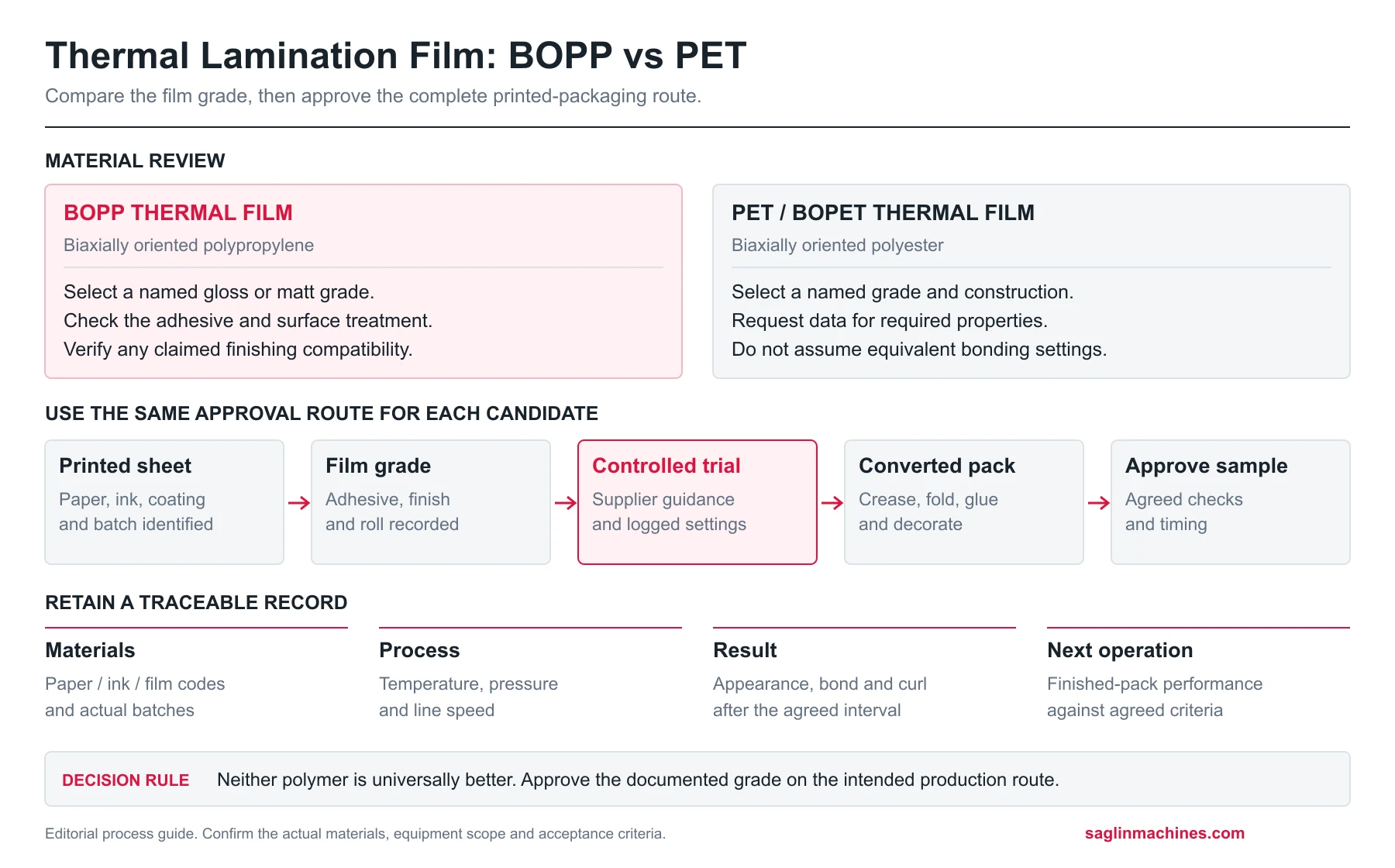
For packaging converters, the useful comparison is therefore not simply "Which film is better?" It is "Which documented film grade produces an acceptable finished package on this production route?"
This guide focuses on thermal film lamination for printed paper and paperboard packaging. It does not cover office pouch lamination.
1. Understand How Thermal Lamination Film Works
Thermal lamination film combines a base film with a heat-activated adhesive layer. In the laminating process, the film and printed substrate pass through a heated bonding arrangement, with the machine's pressure and transport settings contributing to the result.
The exact adhesive and operating requirements depend on the film grade. For example, JPFL describes BOPP thermal products with an extrusion-coated, low-melting polymer layer that enables bonding to paper and paperboard through heat and pressure.[1] Ask for the actual product specification rather than assuming all thermal films share the same adhesive construction.
This process differs from cold adhesive lamination and from bonding a printed sheet to corrugated board. If a project specification uses "lamination" without identifying the materials being joined, clarify it before requesting equipment.
Our comparison of film lamination, flute lamination and litho lamination explains those different production tasks.
2. Compare BOPP and PET Film Grades, Not Labels
BOPP means biaxially oriented polypropylene. PET-based lamination films commonly use biaxially oriented polyester, also described as BOPET.
Both material families are offered as thermal lamination film for printed packaging. Their availability does not make them interchangeable.
A concrete supplier example shows why the grade matters:
| Example grade | Base film and finish | What the manufacturer describes |
|---|---|---|
| JPFL EO-TL | BOPP, gloss | A treated, gloss thermal-lamination grade for paper and paperboard.[1] |
| JPFL EO-MTL | BOPP, matt | A treated matt grade whose stated surface applications include UV coating.[1] |
| JPFL EP-TL | PET, gloss | A treated gloss grade for which the supplier highlights optical, scuff- and tear-resistance properties.[2] |
These are examples, not a recommendation to buy a particular supplier's film or proof of a universal BOPP/PET ranking. Even the stated UV suitability of one matt grade should not be transferred to an unspecified matt film.
For each shortlisted grade, compare total thickness, construction, processing window, relevant dimensional data, roll dimensions and price basis. Then trial the same printed substrate and downstream operations. Ask for measured performance data where a particular scuff, tear or dimensional requirement determines the decision.
In practice, a buyer may shortlist a BOPP grade for one decorative packaging job and a PET grade where the supplier's documented properties better match another requirement. Avoid turning that shortlist into a blanket claim that BOPP is always cheaper or PET always produces a stronger finished pack.
The adhesive layer, thickness, surface treatment and printed substrate still need to be compared. Equal nominal thickness also does not, on its own, establish equal yield or equivalent performance.
3. Choose the Finish With the Next Operation in Mind
Gloss and matt are appearance specifications, but visual preference is only the first part of approval.
Ask the film supplier about the intended downstream operation. A pack may need spot UV, foil decoration, creasing or a glued construction after lamination. Confirm that the selected film surface is suitable for that exact route rather than assuming every decorative finish accepts every coating or adhesive.
Use an approved printed sample to assess:
- Color and image appearance under agreed lighting.
- Surface gloss or matt appearance.
- Scuffing and handling behavior using the customer's agreed method.
- The result of the proposed decoration or bonding step.
- Appearance at folds and creases on a converted pack.
Do not assign one thickness as the correct choice for all folding cartons or premium packaging. Ask what the thickness is expected to achieve, then compare physical samples and processing results.
A thermal lamination film specification should identify the grade, finish and thickness together. "Matt thermal film" is too broad to serve as a repeatable purchasing specification.
4. Check the Printed Sheet Before Adjusting the Laminator
A thermal lamination film bonding problem does not necessarily originate in the laminating machine. The incoming printed sheet is part of the bonding system.
Record the paper or board grade, print process, ink system, print date and any existing coating. Ask the ink and film suppliers how to assess readiness for lamination, including where dense ink coverage or a different print technology is involved.
Where anti-set-off powder is used, include its specification and application in the investigation. Ask the print and film suppliers whether the powder application is suitable for the intended lamination route. Do not prescribe one powder practice to every pressroom without considering its print process.
The receiving inspection should also identify visible contamination, damaged sheets and differences between approved stock and production batches.
Keep these variables separate in the trial record:
| Material information | Why record it? |
|---|---|
| Paper supplier, grade and batch | To distinguish a stock change from a machine-setting change |
| Print process and ink identification | To trace a changed printed surface |
| Time and storage conditions between processes | To make the trial reproducible |
| Powder and other surface-related inputs | To investigate inconsistent contact or surface behavior |
| Film code, roll number and storage history | To trace the consumable actually used |
This information is more useful than describing the incoming material only by its weight.
5. Set Temperature, Pressure and Speed Through a Controlled Trial
Temperature, nip pressure and line speed should be considered together. A displayed roller temperature is not a complete description of the conditions experienced at the film-to-sheet interface.
Begin with the film supplier's instructions and the machine's approved operating range. Do not copy a setting from a different film grade or an unrelated production video.
A practical trial sequence is:
- Define acceptance first. Agree appearance, bonding and downstream conversion checks before testing output.
- Document the starting condition. Record the substrate, film, machine configuration and settings.
- Stabilize the process. Follow the machine's startup procedure and label startup samples separately.
- Make controlled changes. Change one selected factor at a time where practical, or use a documented trial plan when factors must be tested together.
- Retain traceable samples. Identify the settings and sample position without relying on operator memory.
- Assess after the specified interval. Use the material supplier's method and agreed timing, then repeat the required converting checks.
Do not deliberately exceed published material limits or machine ratings to find a stronger bond. If no acceptable operating window appears, investigate the material combination and consult the suppliers.
6. Investigate Bubbles, Curl and Delamination Systematically
The table below is a troubleshooting starting point. Its possible contributors are investigation paths, not diagnoses.
| Observed issue | Possible contributors to investigate | First checks |
|---|---|---|
| Bubbles or a silvered appearance | Incomplete contact, printed-surface condition or an unsuitable process window | Compare defect locations with ink coverage; review film instructions and recorded settings |
| Uneven bonding across the sheet | Uneven process conditions, sheet presentation or local surface differences | Map the affected area and compare it with repeated sheet positions |
| Curl after lamination | Film tension, thermal conditions, paper condition or a one-sided construction | Record curl direction and timing; compare against a retained flat reference |
| Film separation | Film/print incompatibility, unsuitable bonding conditions or contamination | Identify which interface failed and retain samples for the material suppliers |
| Wrinkles or tracking problems | Film path, tension, roll condition or sheet transport | Inspect only as permitted by the machine's safe operating procedures |
| Failure after creasing | The complete paper, film, bond and crease combination | Compare flat-sheet results with converted samples and review crease design |
Describe the failure precisely. "Poor adhesion" could mean film separation from the printed surface, ink lifting, or damage within the paper. Those observations point to different investigations.
Likewise, a defect that appears immediately and one that appears after storage should not be combined into a single undated sample pile.
7. Evaluate the Finished Pack, Not Only the Laminated Sheet
A successful trial should include the operations the customer will actually use. Send approved laminated sheets through the planned cutting, creasing, folding, gluing and decorative steps.
For each candidate thermal lamination film, retain a traceable flat sheet and finished-pack sample. Record the inspection method, time after lamination and pass/fail result against agreed criteria.
Where a bond test is required, agree how it will be performed and interpreted. Do not invent a universal peel value or treat one informal hand test as certification.
Requirements for food contact, recyclability or another regulated application need separate evidence for the complete material structure and intended market. Polymer identity alone does not establish compliance.
8. Match the Film Trial to the Equipment Inquiry
An equipment supplier needs more than the statement "We want a BOPP laminator." Connect the thermal lamination film specification to the intended job mix. Provide:
- The minimum and maximum sheet formats in the intended job mix.
- Representative paper and board samples.
- The film grades, finishes, roll formats and thicknesses under consideration.
- Printed samples, including challenging coverage or surface treatments.
- Required production output and typical order sizes.
- Downstream decoration and converting requirements.
- The acceptance checks the trial must pass.
Use Saglin's film-laminating equipment range to begin the configuration discussion. Ask for the proposed machine's supported materials, limits and included functions to be stated in the quotation.
Prepare a Thermal Lamination Film Approval Record
Before the trial, give each candidate a separate reference code. Connect that code to the supplier's product sheet, film roll label, printed-sheet batch and intended finished pack. Keep an unprocessed printed sheet alongside the laminated and converted samples. This makes later discussions about appearance or a changed input easier to trace.
Define the comparison before looking at the results. If two offers use different film grades, paper, finishes or downstream operations, mark those differences instead of presenting their output as a like-for-like test. Ask the suppliers to identify which proposed inputs are substitutes and which are required for the quoted configuration.
Use a short approval sheet that purchasing, production and quality staff can all review:
| Approval item | What to document before sign-off |
|---|---|
| Material identity | Film grade, finish, thickness, roll reference, printed-stock batch and applicable supplier instructions |
| Trial conditions | Machine configuration, recorded settings, sample sequence and any changes during the run |
| Appearance and bonding | Agreed inspection method, timing, retained sample codes and the observed result |
| Converting route | Cutting, creasing, folding, gluing and decoration actually performed on the trial sheets |
| Exceptions | Unresolved defects, untested requirements, temporary substitutions and who will review them |
| Handover | Approved sample location, responsible staff and the conditions that require another trial |
Separate production samples from startup waste, setting-change samples and rejected output in the record. If output or waste is part of the commercial comparison, agree the counting period and what is included. Record the observation without turning one short demonstration into a guaranteed rate for every future job.
An approval for one thermal lamination film and printed sheet should name that combination explicitly. Do not silently extend it to a different print process, coating, film finish or downstream adhesive. Where the next order changes a relevant input, ask the responsible technical staff whether the existing approval still applies or a new material trial is needed.
Finally, list what the equipment offer includes and excludes. Clarify material handling, roll loading, sheet separation, stacking, utilities, operator training and any separate finishing equipment where relevant to the proposal. Request answers for the actual model under discussion; this checklist is not a statement that every Saglin machine includes those functions.
Keep unresolved items visible in the quotation review. A thermal lamination film trial can support a purchasing decision only for the conditions actually demonstrated. A dated sample set and an agreed exception list are more useful for handover than an unexplained "trial passed" message.
Contact Saglin with the paper, film and finished-pack requirements to arrange a material-specific evaluation.
Frequently Asked Questions
What is thermal lamination film?
It is a film constructed with a heat-activated adhesive layer for bonding to a substrate in a suitable laminating process. The base polymer and adhesive depend on the product.
Is BOPP or PET better for packaging?
Neither is universally better. Compare documented film grades against the required appearance, processing conditions, downstream operations and finished-pack tests.
Can the same settings be used for every thermal film?
No. Start from the exact film supplier's guidance and confirm a suitable operating window using the intended printed sheet and machine.
Why does laminated paper curl?
Curl can involve the film, paper condition, thermal process, tension and construction. Record when and in which direction it develops before changing settings.
Can spot UV or foil be applied after lamination?
Potentially, if the specific film surface and finishing system are compatible. Include the complete sequence in the sample approval.
Technical References
- JPFL Films: BOPP-Based Thermal Lamination Film. Manufacturer descriptions of gloss and matt grades, film construction and stated applications.
- JPFL Films: BOPET-Based Thermal Lamination Film. Manufacturer description of its EP-TL grade. Product claims are not an independent comparison with other films.
