
Flute Laminating Machine Price: What Actually Drives the Cost
Ask five suppliers for a flute laminating machine price and you will get five numbers that differ by a factor of ten, with almost no explanation of why. The short answer: across the whole market the spread runs to roughly seventy to one, from a basic semi-automatic machine to a flagship wide-format full-servo line, and it is driven by format, automation and line configuration, not by brand markup.
This guide breaks the market into five classes, explains the seven factors that actually move the number, adds the hidden costs first-time buyers forget, and finishes with simple ROI math you can rerun with your own volumes. It pairs with our flute laminating machine buyer’s guide and our comparison of the top 10 manufacturers.

How flute laminating machine prices scale across five classes
A flute laminating machine price scales in five steps, and the whole market fits inside a range of about seventy to one. The table below indexes each class against the machine most plants actually buy, a configured automatic 1450 mm line, set at 1.0. Ratios travel better than currency figures: they survive exchange rates, steel prices and the year on the calendar.
| Machine class | Cost relative to the volume class | Who buys it |
|---|---|---|
| Semi-automatic flute laminator | 0.15–0.4× | First step up from hand mounting, short runs |
| Automatic flute laminating machine (1300–1650 mm) | 0.5–1.6× (1.0× = index anchor) | Mid-size box plants (the volume segment) |
| High-speed full-servo line (1450–1700 mm) | 1.6–3.5× | High-volume litho-lam and trade finishers |
| Wide-format (2100 mm) & 5-ply multi-ply lines | 2.2–5.2× | Displays, heavy transit packaging |
| Flagship configured lines | around 11× | Fully loaded wide-format |
The ratios above are built from public marketplace listings and manufacturer-published ranges, then normalised against the 1450 mm class. We deliberately do not publish figures in any currency on this page. A number without your sheet size, board grade and line configuration attached to it is not a price, it is a guess that someone will later hold us to. What the ratios do tell you is which class your volume belongs in, and that is the decision worth getting right before anyone quotes a flute laminating machine price.
Seven factors that drive the price
Seven variables account for almost the entire spread between the cheapest semi-automatic machine and a full-servo line twenty times its cost: format width, automation level, speed class, registration precision, layer capability, component brands and line extensions. They are listed below in the order they usually hit the quotation.
- Format width. The jump from 1300 mm to 1650 mm adds structure, rollers and drives across the whole line. A 2100 mm wide-format machine costs roughly double its 1450 mm sibling.
- Automation level. A semi automatic flute laminating machine price stays low because a person does the feeding. Automatic lines add a top-sheet feeder, bottom feeder, register control and stacker. That package is most of the cost gap between the first two classes.
- Speed class and servo count. Mechanical-drive machines rated 6,000–8,000 sheets/h cost far less than full-servo lines rated 12,000+ sheets/h with independent servo correction at each station.
- Registration precision. ±1 mm is standard for litho-to-corrugated. Machines that hold ±0.5 mm with dynamic multi-sensor registration, needed for board-to-board premium work, carry a premium.
- Layer capability. 5-ply and 7-ply machines carry double feeders and double glue units for heavy-duty corrugated fiberboard. They sit a full class above standard single-pass machines.
- Component brands. Siemens motors, Becker vacuum pumps, Schneider electrics and branded servo packages add real cost over unnamed generics, but they repay it in uptime and spare-parts availability.
- Line extensions. Non-stop feeders, flip-flop stackers, automatic glue kitchens and pallet handling can add 15–30% to the base machine.

Semi-automatic vs automatic: the real cost logic
A semi-automatic machine looks cheap until you price the labour around it: typically two to three operators feeding and stacking, at semi-automatic speeds. An automatic flute laminator price is two to four times higher upfront, but it runs with one operator at two to three times the throughput. Above roughly 150,000–200,000 sheets per month, the automatic machine is almost always the cheaper machine per sheet. That is why the mid class is where the market buys. The operator hours behind that arithmetic, and the monthly volume at which the two options cross over, are set out in our comparison of an automatic flute laminator against a semi-automatic.
Hidden costs to budget beyond the machine
Budget 10 to 20 percent on top of the FOB machine price for costs that never appear on the quotation. The five below are the ones first-time buyers most often leave out of the flute laminating machine price they plan around.
- Freight and insurance. A 1450 mm line ships in multiple containers. Budget around 4 to 5 percent of machine value, depending on destination.
- Unloading, positioning and installation. Budget crane hire, foundation checks and 3×15 m of clear floor with power to match (25 kW class for automatic flute lines).
- Commissioning and training. This is usually included with an engineer visit, but confirm who pays travel and lodging.
- Import duties and certification. Verify that CE (EU) or EAC (CIS) paperwork is machine-specific before shipment, not after.
- Consumables and spares. Starch or PVA glue, doctor blades and belts add up. A sensible first-year spares kit is 2–3% of machine value.

ROI: when does the machine pay for itself?
Payback depends on volume, not on the invoice. Run it as a ratio and you do not need our number at all. Take what you currently pay a trade finisher per sheet. In-house glue, labour and power typically land at a little under half that rate, so treat your saving as roughly 55 percent of the outsourced price per sheet. Multiply that by your monthly sheets, then divide the machine quote by the result: that is your payback in months.
At 250,000 sheets per month a volume-class automatic line clears its own cost in roughly ten months, before counting the lead-time and quality control you bring in-house. Below about 100,000 sheets per month the math weakens, and a semi-automatic machine or continued outsourcing is often the honest answer.

What a SAGLIN quote looks like
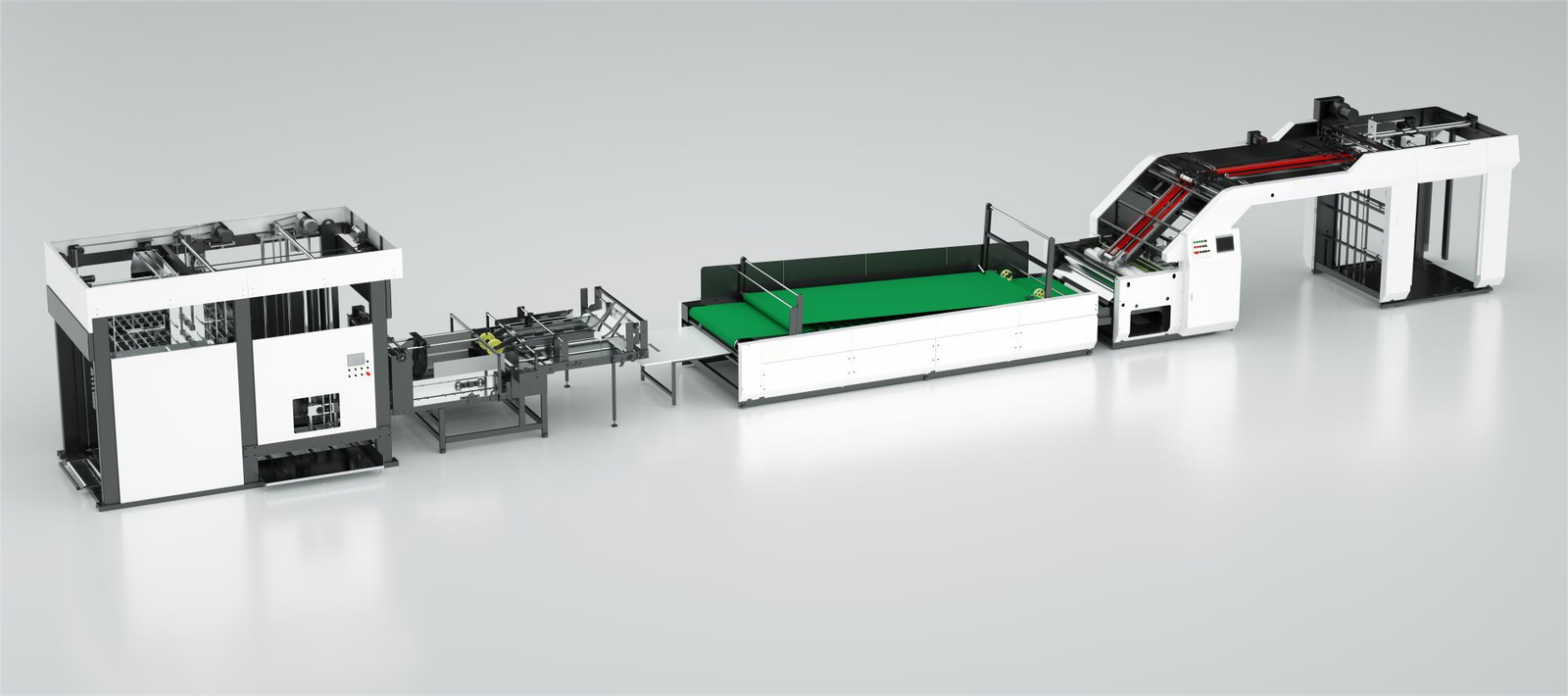
SAGLIN does not publish list prices, because the honest flute laminating machine cost depends on your sheet sizes, board grades and line configuration. Quoting a number before knowing them would be marketing, not engineering. What we commit to: a configured quote within 24 hours of receiving your specs, covering the thirteen-model lamination platform from 800 to 2100 mm, including the workhorse SAGLIN-DX-1450 (1450×1450 mm, up to 12,000 sheets/h). Standard terms: 12-month warranty, 40–60 working days delivery, 30/70 payment, CE certified and EAC-ready.
Frequently asked questions
How much does a flute laminating machine cost?
It depends on class, and the spread is about seventy to one. Index the machine most plants buy, a configured automatic 1450 mm line, at 1.0: a semi-automatic sits at 0.15 to 0.4, a high-speed full-servo line at 1.6 to 3.5, and a flagship wide-format line around 11. SAGLIN quotes per configuration rather than from a list price, because sheet size, board grade and line layout move the number more than the class does.
Is a cheap semi-automatic flute laminating machine worth it?
Below roughly 150,000 sheets per month, yes: the low semi-automatic price beats automation you will not saturate. Above that volume, the extra operators and slower speeds usually make the per-sheet cost higher than an automatic machine’s within two to three years, so compare the flute laminator price against your three-year labour cost, not just the invoice.
What is the HS code for a flute laminating machine?
Most Chinese exporters declare flute laminating machines under HS heading 8420.10 (calendering or other rolling machines), and some use headings under 8441 for paper-converting machinery. National 8–10 digit subdivisions and duty rates differ by country, so confirm the exact code with your customs broker before ordering, because it changes your landed cost.
What is included in a flute laminating machine price?
A typical FOB quote includes the machine, standard tooling, commissioning support and a 12-month warranty. It normally excludes sea freight and insurance, unloading and crane hire, foundations and power supply, import duty and VAT, glue and consumables, and any non-standard feeders or stackers. Together these often add 10–20% on top of the machine price, so ask for the full landed calculation.
What are typical payment and delivery terms for a flute laminating machine?
The industry standard from Chinese manufacturers is a 30% deposit with the balance before shipment (30/70), and 40–60 working days production lead time. SAGLIN quotes these same terms. Add sea freight time to your planning, and schedule the commissioning engineer’s visit when the machine clears customs, not when it ships.
Get a configured quote in 24 hours
Send us your maximum sheet size, board grades and monthly volume, and you will have a complete configured quote (machine, tooling, commissioning and spares) within 24 hours, with a demo on your own substrates available before you commit.
Related reading: Flute Laminating Machine: Buyer’s Guide · Top 10 Flute Laminating Machine Manufacturers (2026)