Paper Bag Production Line: How to Choose
A paper bag production line is a chain of an unwind stand, a tube forming section, a bottom gluing unit and a delivery table that turns a kraft roll into a finished bag with no intermediate sheeting. One line covers one bag format. So the first question when choosing is not what speed it runs, but which bag you sell. The answer decides the whole configuration.
Below are the three working formats, the line broken down stage by stage, the criteria that actually matter when choosing, and what makes up the project budget. The equipment data comes from the specifications of fifteen SAGLIN configurations that we build ourselves.
What a paper bag production line is
A paper bag production line runs from a roll, not from a sheet. The paper unwinds, gets a longitudinal glue seam that forms a tube, receives creasing and scoring for the future bottom, is cut into blanks and moves into the bottom forming section. A counter and a delivery table sit at the exit. One operator is enough, and the work comes down to roll changes, glue control and taking off the stacks.
Continuity is what separates a line from a semi-automatic machine. A semi-automatic takes a pre-printed blank and adds the handle, so it is capped by the output of whatever section cuts those blanks. A roll-fed line has no such dependency, and its real shift output is set by the speed of the machine itself rather than by blank logistics.
Three bag formats, three line configurations
The paper packaging market splits into three stable segments, and a paper bag production line is configured differently for each one. The twisted handle bag covers retail and fast food. The twin handle bag suits producers who sell into retail and into the premium segment at the same time. The flat bottom bag without a handle is the food direction, where the deciding factor is not the handle but the ability to run thin paper.
| Parameter | Twisted handle | Twin handle | Flat bottom, no handle |
|---|---|---|---|
| SAGLIN series | RZFD-T · 7 configurations | RZFD-TF · 6 configurations | RZJD-G · 2 configurations |
| Handle type | Twisted rope | Twisted and flat on one platform | No handle, window optional |
| Bottom type | Square | Square | Flat or square |
| Speed | 30–200 bags/min | 30–150 bags/min | 50–580 bags/min (up to 120 m/min) |
| Paper weight | 50–150 gsm | 80–140 gsm | 35–80 gsm |
| Bag width | 80–550 mm | 120–550 mm | 70–350 mm |
| Max web width | up to 1690 mm | up to 1690 mm | up to 960 mm |
| Inline printing | Option on N models | Option | Window unit optional |
| Installed power | 12–28 kW | 52–55 kW | 19–27 kW plus 5 kW hot melt |
| Who it suits | Retail, fast food, pharmacies | Two markets on one machine | Bread, bakery, dry foods |

The spread in paper weight matters more here than the spread in speed. The 35 gsm floor on the RZJD-G series opens the food segment, which a machine rated from 80 gsm simply never enters. Thin paper tears under acceleration and calls for different web handling, different tension and a hot melt system instead of cold glue.
How the line works, from roll to finished bag
There are six stages, and any of them can become the bottleneck. Knowing the sequence is not a theory exercise. It tells you where to look when you inspect a machine at a supplier.

1. Unwinding and tension
A kraft roll up to 1500 mm in diameter on a Φ76 core sits on an unwind stand with automatic tension control. If tension drifts, the whole downstream drive train will vary in cut length. On lines with inline printing, the register mark sensor sits here as well.
2. Printing, or feeding a printed roll
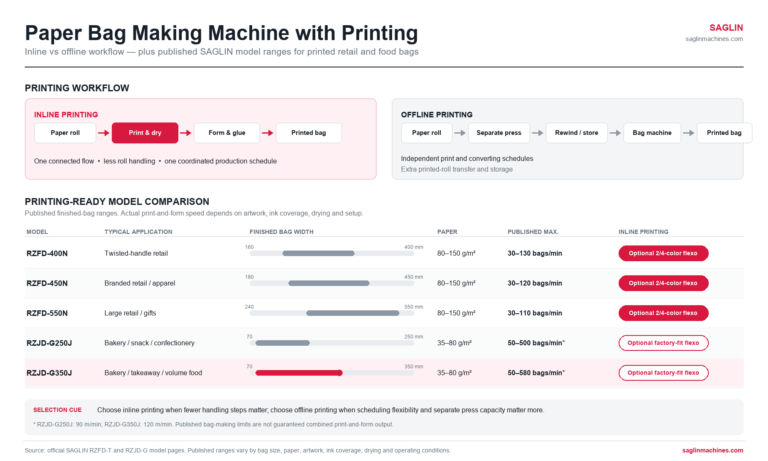
A paper bag production line can print in the flow or run an already printed roll. Inline flexo pays off with a stable product range and long runs. When artwork changes often it is cheaper to print the roll separately, because make ready in the flow stops the entire line rather than one section.
3. Tube forming
The web is folded into a tube and glued along a longitudinal seam. This stage sets the bag width and the bottom width, and it is where the accuracy of the forming plates shows. A one millimetre skew in the seam gives a crooked bag at the exit, and no later stage can cure it.
4. Creasing, scoring and cutting
The tube receives the fold lines for the future bottom and is cut into blanks of the set length. The cut length range decides which bag heights you can run without changing tooling.
5. Bottom forming and gluing
The bottom is opened, folded in and glued. This is the most heavily loaded section, and on cheap machines it is the first place that drifts out of tolerance.
6. Handle and delivery
The twisted handle is rolled from paper tape and glued onto a patch in the flow. A flat handle needs its own unit. Finished bags travel to the delivery table in counted stacks.
What to check when choosing a line
Four parameters decide more than all the rest put together, and a paper bag production line should be judged on these first.
Format range. Look at the minimum, not the maximum. A machine with a 760 mm maximum cut length is easy to sell as universal, but if your volume bag is short, the bottom of the range matters more. Check all three dimensions in the specification at once: cut length, bag width and bottom width.
Paper weight. The lower limit decides which markets you can enter. A line with an 80 gsm floor is closed off from the food segment permanently, and no upgrade gets around that.
Web width and roll diameter. Maximum web width sets the ceiling on bag width, and Φ1200 against Φ1500 directly affects how often the operator walks over to change a roll.
Changeover. Ask the supplier how long the switch between two of your real orders takes. That number says more about a machine than its rated speed, especially with short runs.
When a roll-fed line is the wrong buy
A roll-fed paper bag machine is a capacity purchase, and capacity you do not use still depreciates. It is not in an equipment seller’s interest to say so, but a paper bag production line does not always pay back. There are three situations in which the purchase is a mistake, and it is better to see them before signing than after commissioning.
Volumes below fifty thousand bags a month. At that level the line stands idle for most of the shift while depreciation runs regardless. It is cheaper to place the orders outside or to buy a semi-automatic that works from ready blanks. The payback threshold moves up further if you have many small orders in different formats, because changeover time eats into an already thin load.
A range of ten formats with no clear leader. A line is set up for a range, and the wider your bags are spread across the three dimensions, the more the operator changes tooling instead of making bags. If no single format accounts for at least forty percent of volume, narrow the range first and buy the machine second.
No printing of your own and no reliable roll printing contractor. A line without a printed roll makes a plain bag, and the margin in that segment is thin. Before you calculate payback, make sure you can get a printed roll in your format consistently and at a sane price.
What drives the cost of a line
Almost nobody publishes a price list for a paper bag production line, and the reason is not a closed market. The price is assembled around a configuration. Five factors move the project budget.
Format and width. Going from a 620 mm web to a 1690 mm web changes the whole mechanical design, not just the frame size. Inline printing. A flexo section can cost as much as the base machine.
Handle type. A platform that makes both handle types costs more than a single section machine, but it replaces two parallel lines. Component base. Drives, PLC and servo units from global brands against local equivalents create a difference that shows up in downtime within the first year.
Commissioning and training. These two are often left out at the comparison stage and surface later in the budget, usually once the machine is already on the water.
SAGLIN lines: fifteen configurations on one platform
SAGLIN builds three series of paper bag machines and ships equipment to more than 60 countries. We are the manufacturer rather than a reseller, so the specifications below come from our own assembly sheets.
The RZFD-T series covers the twisted handle bag in seven configurations, from the compact RZFD-190 to the wide format RZFD-550N. The volume model RZFD-330 runs 60–140 gsm paper at up to 180 bags per minute. The N models accept a Φ1500 roll and allow inline printing.
The RZFD-TF series makes both the twisted and the flat handle on one platform in six configurations. The flagship RZFD-330TF reaches 150 bags per minute and has two independent format ranges, one with a handle and one without. For a plant that serves retail and the premium segment, this replaces two parallel lines.

The RZJD-G series is the flat bottom paper bag machine for the food segment. Two configurations, the G250J and the G350J, run paper from 35 gsm at up to 580 bags per minute, which corresponds to 120 metres of web per minute. Machine weight is 5 to 6 tonnes and installed power is 19 to 27 kW plus 5 kW for the hot melt system.

A full side by side overview of the three series with their dimensional ranges sits in the paper bag machines section. General background on the material and its properties is covered in the article on kraft paper.
Lead time, shipping and documentation
Contract terms are standard for project equipment. Payment is 30/70 by T/T, production takes 40 to 60 working days after the down payment, and sea freight to Black Sea and Baltic ports runs 35 to 45 days. EAC certification for Russia and the CIS is handled through our partner HD RUS, takes 30 to 45 days and can run in parallel with production. The machine carries a 12 month warranty.
The control panel ships with bilingual labelling and the documentation is supplied in English. Commissioning and operator training are carried out at your site.
Need a configuration for your bag format?
Send a bag sample or a drawing with all three dimensions and the paper weight. We will select the configuration and send a specification with realistic output per shift. Contact SAGLIN.
Frequently asked questions
What is a paper bag production line?
It is a continuous line made up of an unwind stand, a tube forming section, a creasing and cutting unit, a bottom gluing section and a delivery table. It turns a kraft roll into a finished bag with no intermediate sheeting. One line is built around one bag format, and the configuration is selected for that format.
How many bags per minute does a paper bag line make?
From 30 to 580 bags per minute depending on the format. A twisted handle bag runs at 30 to 200 bags per minute, a twin handle bag at 30 to 150, and a flat bottom food bag up to 580. The rated maximum is reached on a short bag in thin paper, so output should be counted at your own real format.
What paper weight does a paper bag line need?
The range is 35 to 150 gsm depending on the series. Flat bottom food bags are made from paper from 35 gsm, while bags with a handle need 50 gsm and above. The lower limit of the range matters more than the upper one, because it decides which market segments the machine can enter.
How does a roll-fed line differ from a semi-automatic machine?
A line works from a roll and completes the whole cycle continuously, while a semi-automatic takes a pre-printed blank and adds the handle. A semi-automatic depends on the output of the blank cutting section, and a roll-fed line has no such dependency. At a comparable format the line needs one operator instead of several.
Do you need inline printing on the line?
Inline flexo printing pays off with a stable product range and long runs. When artwork changes often it is more profitable to print the roll separately, because make ready in the flow stops the entire line. At SAGLIN inline printing is available as an option on the N series models.
What is the lead time for a paper bag line?
Production takes 40 to 60 working days after the down payment and sea freight runs 35 to 45 days to Black Sea and Baltic ports. EAC certification through our partner HD RUS takes 30 to 45 days and can run in parallel with production. Payment is 30/70 by T/T and the warranty is 12 months.