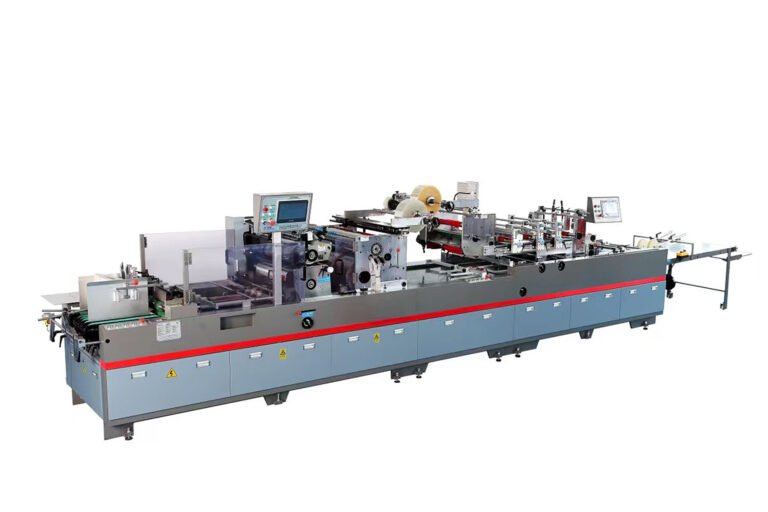
Cast and Cure: How It Works and Which Line to Buy
Cast and cure is a decorative coating process that presses a holographic pattern into a wet UV varnish and cures it in place, so the pattern stays in the coating and the film comes back off. The film is not consumed and not left on the sheet, which is what separates it from holographic lamination and from hot foil. For a converter the practical question is not what the effect looks like, because every supplier shows the same rainbow sample. The question is which route you buy into, and that decision splits cleanly in two.
This guide covers what the process actually demands, the two equipment routes and how to choose between them, what drives the cost, and where the process is the wrong answer. Specifications come from our own build sheets for the SAGLIN screen finishing lines.
What cast and cure actually is
A UV coating or varnish is applied to the printed sheet, usually by screen or by a coater. While that coating is still wet, a casting film carrying a microscopic diffraction pattern is laminated against it. UV lamps cure the coating through the film, the pattern sets into the hardened surface, and the film peels away and rewinds for reuse.
The result is a holographic effect that lives in the varnish layer itself. Nothing metallic and nothing plastic stays on the carton. That is the property most often missed in the sales material, and it is the one that matters commercially, because it is what makes the carton recyclable through a normal paper stream.
The industry shorthand for this on a finished sheet is tear and no film. Tear the carton and you will not find a laminated layer to peel back, because there is none. A holographic laminate fails that test immediately, and so does a metallised transfer.
Cast and cure, holographic lamination and hot foil compared
These three produce a broadly similar shelf effect and are routinely confused in specification meetings. They behave very differently in production and at end of life.
| Cast and cure | Holographic lamination | Hot foil | |
|---|---|---|---|
| What ends up on the sheet | Cured varnish only | A laminated plastic film | Transferred metallic foil |
| Tooling | Screen or plate, no engraved die | None | Engraved brass die per design |
| Artwork change | New screen or plate | New film | New die, lead time and cost |
| Heat | None, UV cure | Adhesive dependent | Heated die, dwell time |
| Consumable behaviour | Casting film is reused | Film is consumed | Foil is consumed |
| Recyclability | Paper stream, no film layer | Compromised by the film | Depends on coverage |
| Best at | Large areas and full backgrounds | Whole panel effects | Small sharp metallic marks |

The consumable line is where the running cost argument sits. A casting film is used across many passes before it is retired, so the film cost per sheet falls as you run it, while laminating film and foil are gone after one pass. That advantage only materialises at volume, which is a point most process explainers leave out.
Two routes to the process, and how to choose
Everything on the market falls into one of two shapes, and this is the decision that actually costs money. Get it wrong and you will either underuse a line or bottleneck a press you already depend on.

Route one, a retrofit casting unit
A casting and curing unit is mounted onto a press you already own, most often an offset, flexo or gravure line. Suppliers who work this way include Eagle Systems and Breit Technologies, and this is the route most of the equipment content online describes. Capital outlay is lower because you are buying a unit rather than a line, and the footprint is whatever the press bay already gives you.
What you give up is scheduling freedom and coating latitude. The casting unit is now tied to that press, so every casting job competes with everything else that press is booked for. You are also limited to the coating weight and the cure energy your host press can deliver, which constrains how deep a pattern you can set on heavy board.
Route two, a dedicated screen line
A screen press lays the varnish and an inline unit does the casting, curing and any other decoration, as one continuous pass on its own machine. Capital outlay is higher and you need the floor space, roughly 9 metres of run length on our own configuration. In exchange the line runs on its own schedule, screen deposits a far heavier coating film than a standard coater, and registration is set by the press rather than inherited.
The heavier deposit is the technical reason converters move to this route. A deeper varnish layer holds a deeper diffraction pattern, which is what makes the effect read across a room rather than only in the hand.
What the process demands from substrate and coating
The process is less forgiving on inputs than the marketing suggests, and three constraints decide whether your job is a candidate at all.
The surface must be closed. The varnish has to sit on top of the substrate rather than soak into it. Coated board and coated papers work. Uncoated kraft and exposed corrugated flute liner absorb the varnish, the diffraction pattern collapses, and you get a dull patch instead of a hologram.
Board weight has a floor. Our own line runs the casting and curing unit from 128 up to 450 g/m², and the screen press handles 90 to 420 g/m². Below that floor the sheet does not carry cleanly through the transport at speed.
Cure energy has to match the coating. Undercure leaves a soft surface that scuffs in the folder gluer, and overcure embrittles it. On our configuration the unit carries five 8 kW UV lamps precisely because three processes may need curing in the same pass, and that is a specification worth comparing quote to quote rather than assuming.
What drives the cost
Nobody publishes a price for this equipment, and the reason is that the figure is assembled per configuration rather than withheld. Five factors move it more than anything else.
Retrofit unit versus complete line is the largest single fork, and it is a difference of category rather than of degree. Working width matters because a B1 format machine is a different build from a small format one, not a scaled one. How many processes share the pass changes the lamp and unit specification, since a line that also does cold foil and spot UV needs curing capacity for all three. Casting film supply is an ongoing cost and the pattern library you can draw on varies sharply between suppliers. Component base, meaning the drives, PLC and servo units, shows up in year one as uptime rather than as a line on the quotation.
Casting film, patterns and supply
The casting film is the consumable that decides both your running cost and your design range, and it is the part buyers investigate last. It is a PET carrier embossed with a diffraction pattern, laid against the wet varnish and pulled back off after cure. Because it is not consumed in the way foil is, one roll serves many passes before the pattern degrades and it is retired.
How many passes you get is the number to ask for, and it is not a constant. Film life falls with heavier coating weights, with aggressive cure settings and with abrasive board, so a figure quoted from a supplier demo is an upper bound rather than a working average. Ask what the film costs per roll, what pass count they see on board like yours, and whether retired film has a disposal route in your country.
Pattern range matters more than most specifications. Suppliers hold libraries of stock patterns covering linear diffraction, pillars, lenses and geometric fields, and stock patterns carry no origination charge. A custom pattern, including one carrying a brand mark for security work, means originating a new shim and a minimum order, which changes the economics of a job completely.
Film width has to match your working width or you pay for material you trim away. Our own unit takes rolls to 1060 mm wide at up to 400 mm diameter, which sets both the maximum sheet it can cover in one pass and how often an operator stops to change a roll.
Where the process is the wrong answer
Three cases come up often enough to state plainly, and a supplier has no incentive to raise them with you.
Small sharp metallic marks. A thin metallic rule or a fine serif logo in gold still belongs to foil. Casting produces diffraction, not metal, and at small sizes the effect reads as a smudge rather than as shine.
Uncoated and rough stock. Covered above, and it is absolute rather than a matter of degree. If your product range is kraft mailers and plain corrugated, this process is not for you and no amount of coating adjustment fixes it.
Short runs with constant artwork changes. The economics rest on amortising the casting film across many passes. A shop running fifty different jobs a month at two thousand sheets each will never reach the point where the consumable advantage appears.
The SAGLIN screen finishing line
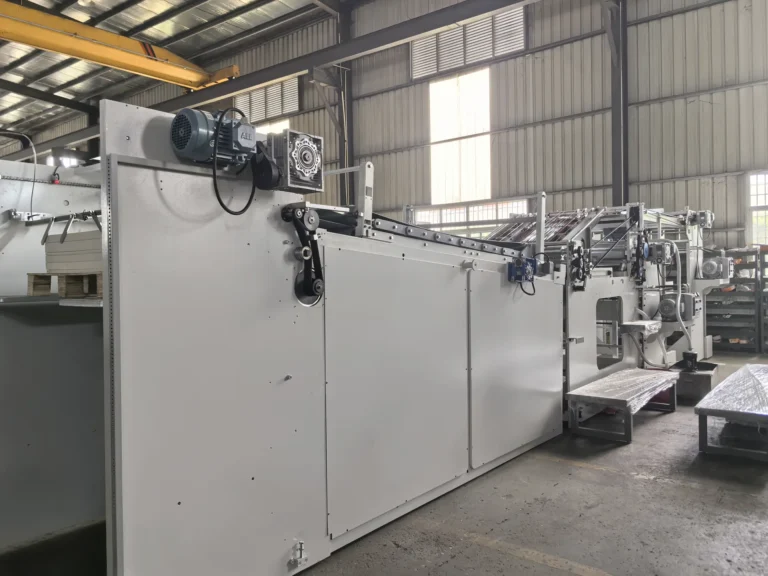
SAGLIN builds the dedicated line route. The configuration that runs cast and cure is the SAGLIN-GST-1060 screen press paired with the SAGLIN-GUVY-1060ACS unit, and it runs cold foil stamping, hologram transfer and spot UV varnishing on a single B1 pass.

The screen press works to 1050 by 740 mm at 500 to 4,000 sheets an hour with registration held at 0.1 mm or better. The finishing unit takes 128 to 450 g/m² board, carries five 8 kW UV lamps, and runs at 4,000 sheets an hour on spot UV and hologram or 2,500 on cold foil. The line occupies roughly 9.0 by 3.0 by 3.8 metres and draws about 94 kW.
Running three decorations in one pass is the reason the configuration exists. Premium cosmetic cartons and pharmaceutical anti-counterfeit cartons typically want metallic detail, a holographic security element and selective gloss on the same sheet, and doing that across three separate machines means three handling cycles and three registration risks.
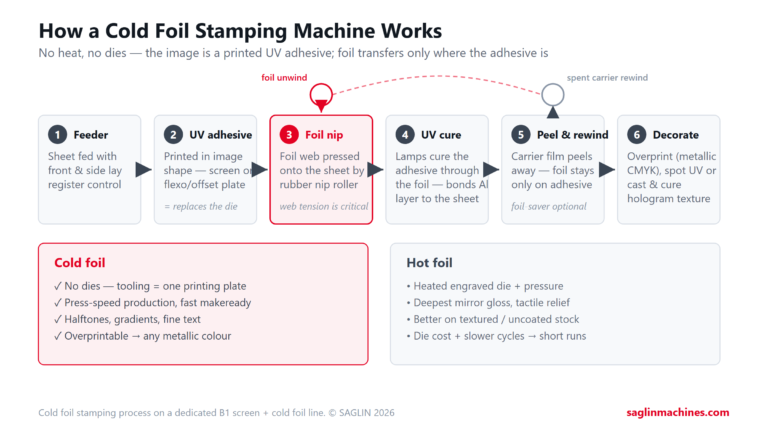
If you only need metallic and gloss without the hologram, the cold foil and spot UV line is the shorter configuration. Background on the cold foil side of the platform is in our cold foil stamping machine guide, and the full platform sits under screen finishing lines. General background on the curing chemistry involved is covered in the Wikipedia entry on UV curing.
Frequently asked questions
What is cast and cure in printing?
Cast and cure is a decorative coating process where a holographic pattern is cast into a wet UV varnish and cured in place, after which the casting film peels away and is reused. The pattern stays in the coating rather than as a layer on top, so the sheet carries no laminated film. This is why such a carton passes the tear and no film test and can go through a normal paper recycling stream.
What machine do you need for cast and cure?
Either a casting and curing unit retrofitted onto a press you already own, or a dedicated line where a screen press lays the varnish and an inline unit does the casting and curing. The retrofit route costs less and suits shops with genuinely spare press hours. The dedicated line route deposits a heavier coating for a deeper effect and runs on its own schedule.
How much does a cast and cure machine cost?
Suppliers quote per configuration rather than publishing a price. The largest factor is whether you buy a retrofit unit or a complete line, followed by working width, how many processes share the pass, casting film supply terms and the component base. Compare offers on total installed curing power, film patterns included, and local spares support rather than on headline price alone.
Is cast and cure the same as holographic film lamination?
No, and the difference is what stays on the sheet. Lamination bonds a holographic plastic film to the carton and that film remains there permanently. Casting transfers only the pattern into the varnish and takes the film back for reuse, which is both cheaper per sheet at volume and better for recyclability.
What substrates work with cast and cure?
Coated board and coated papers with a closed surface work well. Uncoated kraft and exposed corrugated liner do not, because they absorb the varnish and the diffraction pattern collapses into a dull patch. Board weight also has a working floor, which on our line is 128 g/m² for the casting and curing unit.
Can cast and cure run with cold foil and spot UV on the same pass?
Yes, on a line specified for it. The SAGLIN-GUVY-1060ACS unit runs cold foil stamping, hologram cast and cure transfer and spot UV varnishing in a single B1 pass, which is why its lamp configuration is upgraded to five 8 kW UV lamps. Running all three on one pass removes two handling cycles and two registration risks compared with three separate machines.