Cold Foil Stamping Machine: How It Works & Costs
A cold foil stamping machine applies metallic foil to paper or board using a UV-curable adhesive and pressure — no heat, no engraved dies. For packaging converters, that changes the economics of metallic decoration: makeready drops from hours to minutes, per-job tooling cost drops to the price of a printing plate, and the foil can be overprinted to produce any metallic colour from a single silver base.
This guide explains how the cold foil stamping process works station by station, where it beats hot foil stamping and where it doesn’t, the difference between inline units and dedicated offline lines, and what actually drives the price of a machine. It is written for folding-carton plants, label converters and trade finishers evaluating their first foil investment or replacing hot-stamp capacity.
What is cold foil stamping?
Cold foil stamping (also called cold foil printing or cold foil transfer) is a decoration process in which a UV-curable adhesive is printed onto the substrate in the exact shape of the design — using a standard printing plate or a screen — and a metallised foil web is then pressed against the sheet. The same equipment is listed by suppliers both as a cold foil stamping machine and as a cold foil printing machine — they are one product. Where there is adhesive, the foil’s aluminium layer transfers; where there is none, it stays on the carrier film. A UV lamp cures the adhesive, the spent carrier rewinds, and the sheet exits with a bright metallic image that can be overprinted in the same pass.
Because the “image” is defined by a printed adhesive rather than a heated brass or magnesium die, cold foil handles halftones, fine linework and large solids equally well, and a design change costs one new plate instead of one new die.
Cold foil vs hot foil: the question everyone asks
This is the single most-searched comparison in the category, so here is the honest version:
| Cold foil stamping | Hot foil stamping | |
|---|---|---|
| Image carrier | Printed UV adhesive (plate or screen) | Heated engraved die + pressure |
| Tooling cost | Printing plate — low, fast to remake | Brass/magnesium die — higher, days of lead time |
| Speed | Runs at press speed (thousands of sheets/h) | Slower, cycle-limited on platen presses |
| Detail | Excellent for halftones, gradients, fine text | Excellent for solids; halftones difficult |
| Finish | Bright, flat metallic; overprintable for metallic CMYK | Deepest mirror gloss; can emboss simultaneously |
| Tactile relief | None — foil sits flush with the sheet | Yes — die pressure gives a debossed/embossed feel |
| Substrates | Best on smooth coated paper and board | More forgiving on textured and uncoated stock |
| Best run lengths | Medium to long runs, versioned designs | Short premium runs, luxury tactile effects |
The practical rule: choose cold foil when you need metallic effects at production speed, in fine detail, or in colour (foil + overprint); keep hot foil when the brief demands tactile relief, mirror-deep gloss on uncoated stock, or combined foil-and-emboss in one hit. Many premium cartons use both on the same sheet.
How a cold foil stamping machine works, station by station
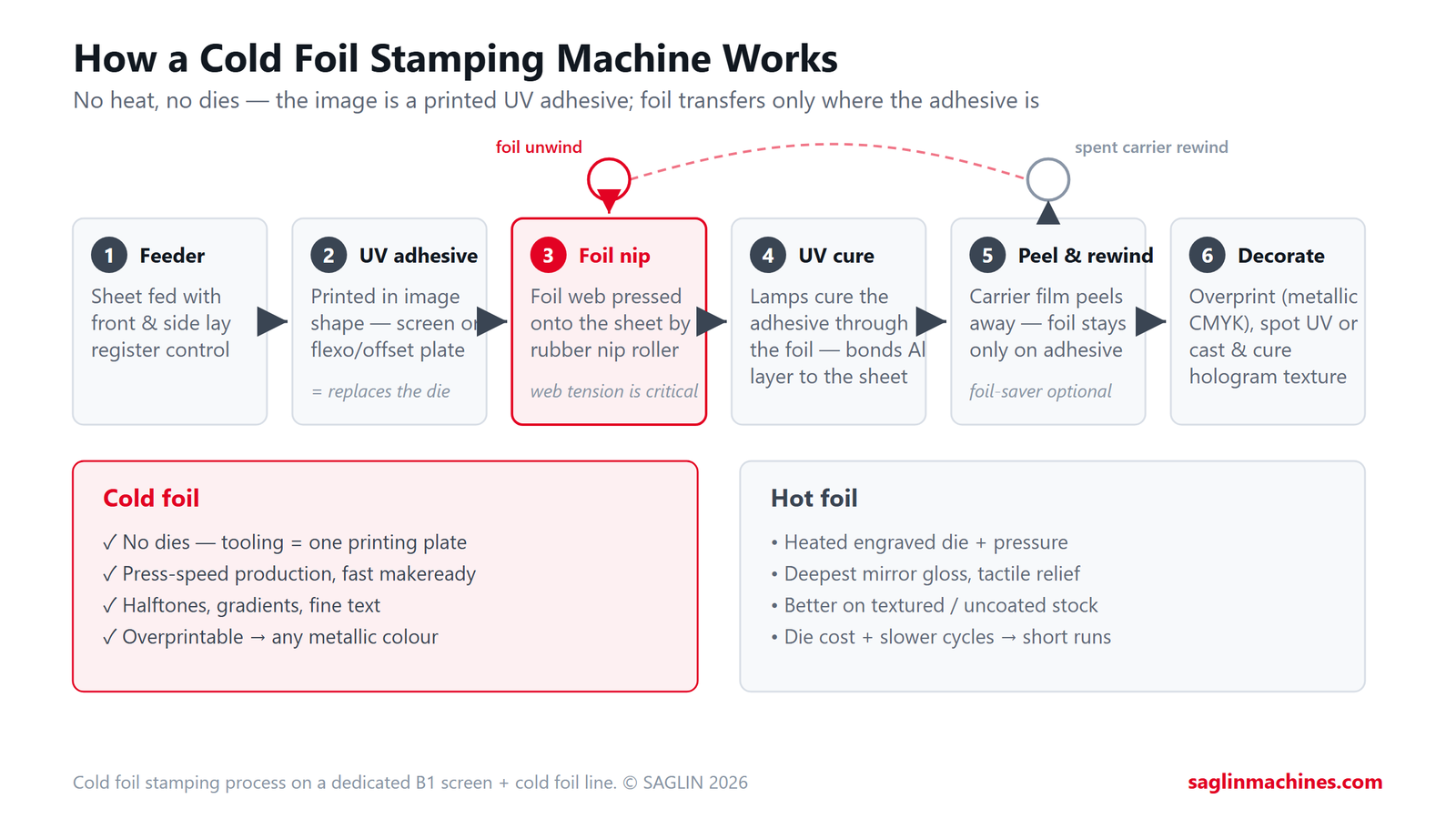
Every cold foil stamping machine — inline or offline — runs the same six stations:
- Feeder. Sheets are fed with register control — foil placement is only as accurate as sheet transport, so look for the same front-lay/side-lay quality you would demand of a printing press.
- Adhesive station. A UV-curable cold foil adhesive is printed in the image areas — flexo or offset plate on inline units; a stop-cylinder screen press on dedicated lines, which lays a thicker, sharper-edged film for packaging work.
- Foil nip. The foil web unwinds and is pressed against the sheet by a rubber-covered nip roller. Web tension control matters: too loose and the edges feather, too tight and the foil bridges fine reverses.
- UV curing. UV lamps cure the adhesive through the foil, bonding the aluminium layer to the sheet.
- Peel and rewind. The carrier film peels away at a controlled angle, taking unused foil with it. The spent web rewinds for disposal or foil-saver optimisation.
- Downstream decoration. Because the sheet exits flat and cured, it can be overprinted (metallic CMYK), spot-UV coated, or — on combination lines — given a cast-and-cure hologram texture in the same pass.
Inline units vs dedicated cold foil lines
Inline cold foil units bolt into an offset or flexo press: the first unit prints the adhesive, a bridge unit nips and cures the foil, and the remaining units overprint. This suits printers with spare press units who want metallic capability at minimum capital cost — but it consumes two press units and ties foiling to that press’s schedule.
Dedicated (offline) cold foil lines — like the SAGLIN screen cold foil lines — separate embellishment from printing. A stop-cylinder screen press lays the adhesive, followed by foil transfer, UV curing and optionally hologram cast-and-cure and spot UV in one B1-format pass. A dedicated cold foil stamping machine costs more than a retrofit unit but keeps your printing press printing, runs any sheet from any press, and combines effects that inline units cannot.
What drives the price of a cold foil stamping machine?
Public listings for a cold foil stamping machine span an enormous range, and most of the spread comes down to five factors rather than brand premium:
- Format width — narrow-web label units cost a fraction of B1 (1,060 mm) sheet-fed lines;
- Inline retrofit vs dedicated line — a press attachment reuses your press’s transport; an offline line buys its own feeder, transport and delivery;
- Adhesive station type — flexo coating heads are cheaper; stop-cylinder screen stations lay the premium adhesive films packaging buyers pay for;
- Combination effects — adding cast-and-cure hologram and spot UV stations turns a foil machine into a full embellishment line, with pricing to match;
- Foil-saver systems — indexing units that skip-feed the foil web can cut foil consumption dramatically on sparse designs, and pay for themselves on long runs.
Because configurations vary this much, treat any single list price with suspicion and compare configured quotes — same width, same stations, same automation — or you are comparing different machines.
SAGLIN cold foil & embellishment lines
SAGLIN ships five to ten machines every month, with finishing lines running in more than 20 countries, CE-certified and EAC-ready for CIS markets. The cold foil stamping range is built around a stop-cylinder screen press platform in B1 format:
- Screen + cold foil line — screen-printed UV adhesive plus foil transfer for sharp-edged, high-opacity metallic graphics on cartons and rigid-box wraps.
- Cold foil & hologram transfer line (GST-1060 + GUVY-1060ACS) — cast-and-cure holographic texture, cold foil and spot UV combined in a single B1 pass at up to 4,000 sheets/hour: one line instead of three machines and three handling steps.
- Spot UV coating line (GUV/IR-1060) — high-gloss, spot-gloss and tactile wrinkle textures at 1,100 mm width, as a standalone or paired with the foil lines.
All lines carry a 12-month warranty with 40–60 working days standard delivery, and can be demonstrated on your own substrates before you commit.
Frequently asked questions
What is the difference between hot and cold foil stamping?
Hot foil stamping transfers foil with a heated engraved die under pressure, giving deep gloss and a tactile impression but requiring die tooling and slower cycle speeds. Cold foil stamping prints a UV adhesive in the image shape and transfers foil with pressure and UV curing only — no heat, no dies — so it runs at press speed, handles halftones and fine detail, and can be overprinted for metallic colours. Cold foil wins on speed, detail and tooling cost; hot foil wins on tactile depth and performance on textured, uncoated stock.
What are the disadvantages of cold foil stamping?
Cold foil needs smooth, coated substrates for a bright result — on rough or uncoated stock the foil follows the surface texture and loses brilliance. It produces no embossed relief, its mirror gloss is a step below a well-struck hot stamp, and the process consumes a full-width foil web unless the machine has a foil-saver system. For tactile luxury effects, hot stamping or combination decoration remains the better tool.
Do I need a die for cold foil stamping?
No. The image is defined by a printed UV adhesive — from a standard flexo/offset plate or a screen — so there is no engraved die to buy, store or re-make. That is the main reason cold foil makeready and per-design tooling costs are so much lower than hot stamping, especially for versioned or frequently changing artwork.
How much does a cold foil stamping machine cost?
It depends less on brand than on configuration: format width, inline retrofit versus dedicated line, flexo versus screen adhesive station, added hologram/spot-UV stations, and foil-saver automation. Narrow-web and retrofit units sit at the low end; full B1 combination embellishment lines at the high end. Compare configured quotes at identical width and station count — and ask us for a configured SAGLIN quote as your benchmark.
How can you tell if a print uses cold foil or hot foil?
Run a fingertip over it: hot foil usually sits in a slight impression you can feel, while cold foil is completely flush with the sheet. Under a loupe, cold foil shows halftone dots and fine gradients (impossible with a die), and overprinted metallic colours are a strong cold foil signature. Hot foil shows sharper edge walls and often a faint emboss on the sheet’s reverse.
Talk to SAGLIN
Tell us your sheet size, substrates and the effects you want to sell — cold foil, hologram, spot UV or all three in one pass — and our engineers will configure the right cold foil stamping machine for the job, with a witnessed demo on your own artwork if required.
Related reading: Flute Laminating Machine: Buyer’s Guide for Corrugated · Window Patching Machine: Buyer’s Guide